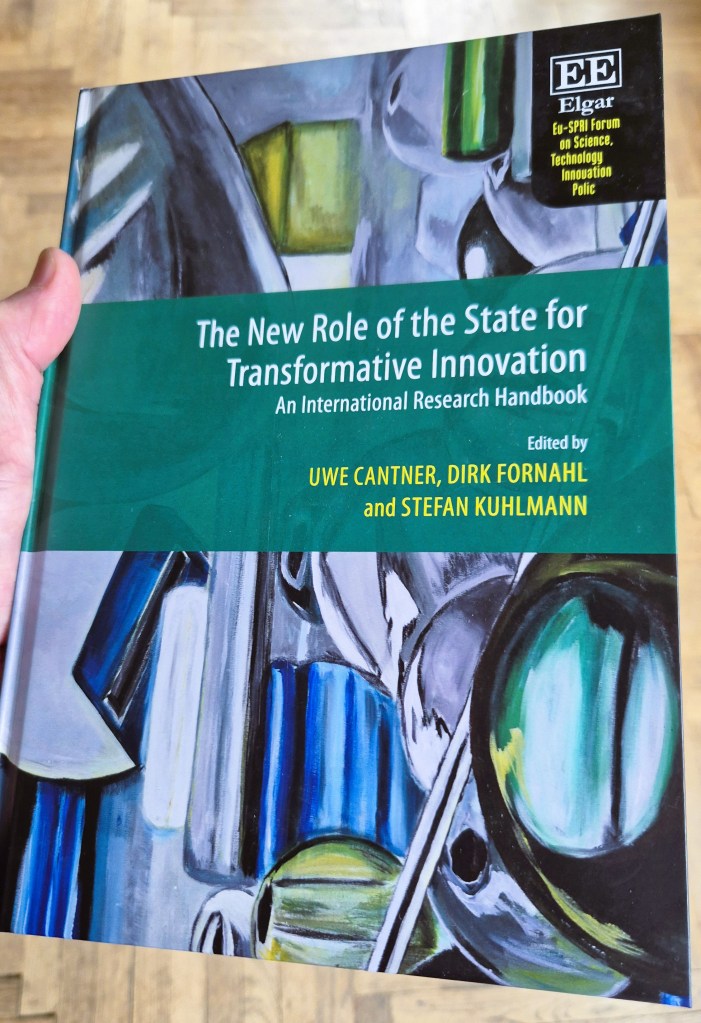
Our research handbook “The New Role of the State for Transformative Innovation” (Edward Elgar Publishing, 2026) examines the evolving role of the State in fostering transformative innovation amid 21st-century challenges including climate change and geopolitical shifts. In 27 chapters more than 50 world leading scholars present state-of-the-art expertise about options and limitations of State governance and action.
Drawing on this comprehensive knowledge, in the book’s introduction (download), we identify ten building blocks for transformative State innovation policy, emphasizing mission-oriented approaches, whole-of-government coordination, experimental policy learning, and socially acceptable change management.
In an afterword to the book (download) we also reflect on very recent challenges. Since 2020, rising libertarian and nationalist movements—particularly in the United States—undermine innovation policy frameworks by reducing State agency, prioritizing corporate interests, and rejecting climate action and inclusive development goals. This ideological shift threatens coordinated international efforts toward sustainability and equity, fragmenting the global innovation landscape into competing blocs. Therefore, we argue for a “strategically reflexive State” that combines long-term missions with adaptive governance, balancing global cooperation with domestic resilience while maintaining commitment to public welfare and inclusive transformation despite mounting geopolitical tensions.
Uwe Cantner, Dirk Fornahl, Stefan Kuhlmann (editors)
The book is available as eBook and Hardback.